Clarification in explaining the revision
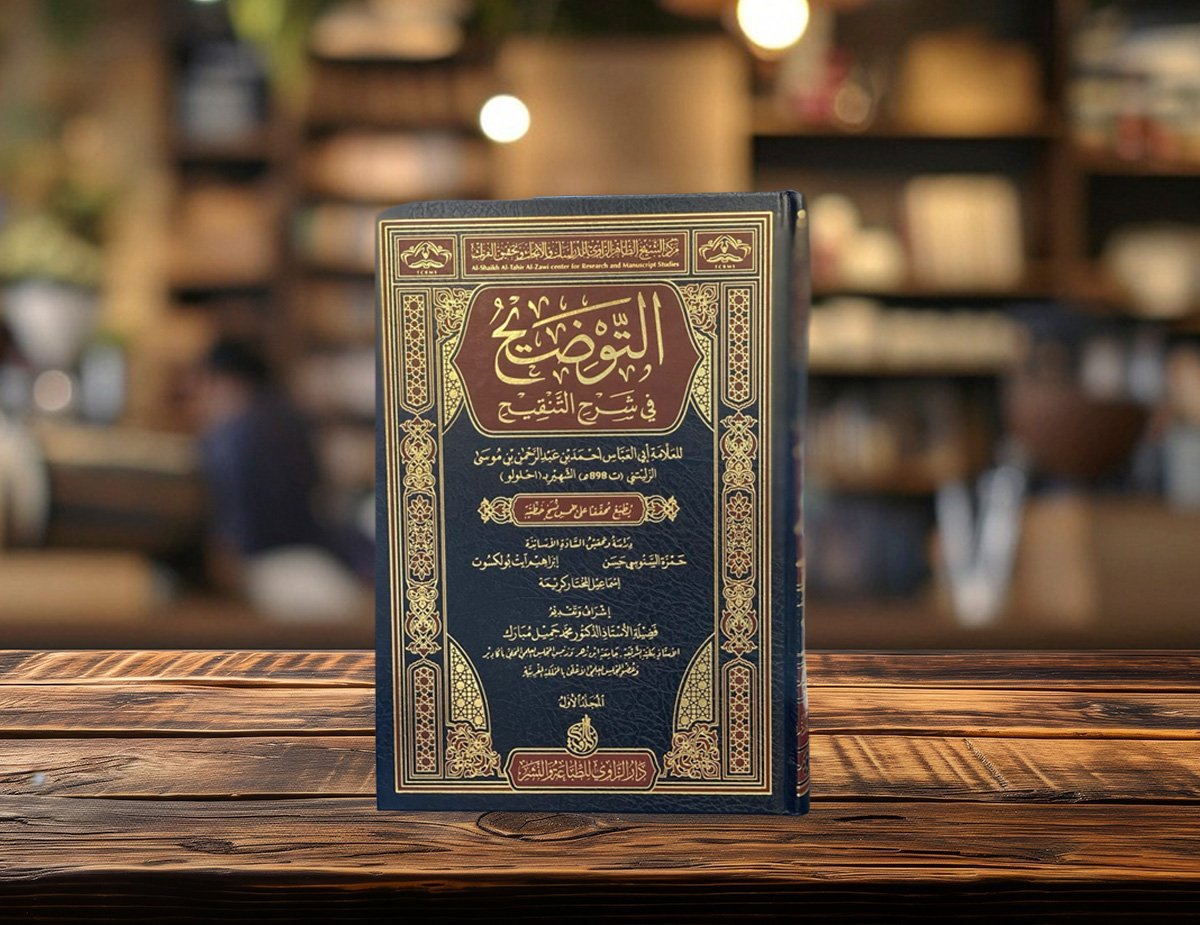
Authored by the renowned scholar and judge, Abu al-Abbas Ahmad ibn Abd al-Rahman ibn Musa al-Zalitni al-Maliki, famously known as “Halulu,” who died in 898 AH. Edited by: Professor Hamza al-Sanusi Hassan, Dr. Ibrahim Ait Boulksout, and Dr. Ismail al-Mukhtar Karima.
This book is a foundational text, its unique insights enriching minds and its benefits widely transmitted. It has undergone rigorous research, meticulous editing, and exquisite embellishment. It was originally written by a scholar from Libya in the ninth century AH, and revived over five hundred years later by Maghrebi students (from Libya and Morocco). The Sheikh Taher Al-Zawi Center for Studies, Research, and Heritage Preservation has had the honor of publishing it in a meticulously crafted and embellished edition, within a Maghrebi context, thus strengthening scholarly ties and extending cultural connections.
The book was edited based on five manuscripts, in three volumes. It originated as three Master’s theses in Islamic Law at the Faculty of Sharia, Al-Qarawiyyin University, Agadir branch, under the supervision of the esteemed scholar, Professor Dr. Muhammad Jamil Mubarak (may God preserve him), a professor at the Faculty, during the academic year 2007-2008. These theses are as follows:
The first: “The Study Introduction, and from the beginning of the book to the end of the fourth chapter of the section on commands,” edited by Professor Hamza Al-Sanusi Hassan (may God have mercy on him), and defended on February 26, 2009, with the participation of the two distinguished professors: Professor Dr. Moulay Al-Hussain Al-Hayyan (may God have mercy on him), a professor at the Faculty of Sharia, Al-Qarawiyyin University, and Professor Dr. Ibrahim Al-Wafi (may God preserve him), a professor at the Faculty of Arts and Humanities, Ibn Zohr University.
The second dissertation, “From the beginning of Chapter Five: On Matters Not Required by the Command, to the end of the discussions on general and specific matters,” was edited by Dr. Ibrahim Ait Boulksout (may God preserve him). It was defended on July 8, 2008, by a panel of two esteemed professors: Professor Dr. Abdel Moneim Hamiti (may God preserve him), Professor at the Faculty of Sharia, Al-Qarawiyyin University, and Professor Dr. Abdelwahed El Idrissi (may God preserve him), Professor at the Faculty of Arts and Humanities, Ibn Zohr University.
The third dissertation, “From the beginning of Chapter Thirteen: On the Actions of the Prophet (peace and blessings be upon him), to the end of the book,” was edited by Dr. Ismail Mokhtar Karima. It was defended on February 26, 2009, by a panel of two esteemed professors: Professor Dr. Moulay El Houssine El Hayyan (may God have mercy on him), Professor at the Faculty of Sharia, Al-Qarawiyyin University, and Professor Dr. Ibrahim El Wafi (may God preserve him), Professor at the Faculty of Arts and Humanities, Ibn Zohr University.
All three dissertations were approved with a recommendation for publication and distribution among universities. When the Sheikh Taher Al-Zawi Center for Studies, Research, and Heritage Preservation nominated this book, along with other important Maliki texts, a specialized scholarly committee was formed to conduct a rigorous academic review before its publication. This committee consisted of the following distinguished professors:
Professor Dr. Abdul-Munim Hamiti, Professor at the Faculty of Sharia, Ibn Zohr University, Agadir, Morocco.
Professor Dr. Issam Muhammad Al-Sari, Professor at the Faculty of Sharia and Law, Al-Asmariya University, Zliten, Libya.
Professor Dr. Bilal Faisal Al-Bahr, Researcher at Al-Basair Foundation for Studies and Publishing, Istanbul, from the scholars of Iraq.
This edition was prefaced by the eminent scholar Professor Dr. Muhammad Jamil Mubarak, may God preserve him, Professor at the Faculty of Sharia, Ibn Zohr University, Head of the Local Scientific Council in Agadir, and Member of the Supreme Scientific Council of the Kingdom of Morocco. This blessed book explains a concise summary of the Maliki school of jurisprudence, namely, “Tanqih al-Fusul” by Imam Ahmad Shihab al-Din al-Qarafi (d. 684 AH), which scholars have dedicated themselves to explaining, annotating, memorizing, and teaching due to its paramount importance in the study of legal theory.
The scholar Halulu, may God have mercy on him, called for the compilation of this commentary because of “the clear expression, evident meaning, and clear indication contained in the book ‘Tanqih,’ along with the benefit of attributing certain issues to the scholars of the school.” However, it contains some unclear expressions and deficient points regarding the source of the investigation. Therefore, I wanted to supplement its benefits, address its ambiguities, and clarify some of its objectives so that they may fully benefit from it.
What distinguishes this commentary is its reliance on books that are now considered lost or unpublished manuscripts, such as Imam al-Ash’ari’s “Answer to the Basran Questions,” Qadi Abu Bakr al-Baqillani’s “Guidance,” Imam al-Mazari’s “Commentary,” and Imam Ibn ‘Arafa’s “Abridged Principles of Islamic Jurisprudence.”
This book is also considered a comprehensive encyclopedia of the opinions of scholars of Islamic jurisprudence in general, and Maliki scholars in particular, as it includes the views of many of them, such as Imam al-Baqillani, Imam Ibn al-Qassar, Imam al-Abhari, Qadi ‘Abd al-Wahhab, Imam al-Mazari, Imam al-Baji, Imam al-Abyari, Imam Ibn al-Hajib, and others, may God have mercy on them.